


 By
By The emergency caused by the earthquakes in Venezuela is beginning to reveal a second zone of devastation: not that of damaged buildings or streets occupied by families left without shelter, but that of allegations pointing to the opaque handling of aid, the obstruction of rescue workers, the political control of relief and the appropriation of supplies intended for those affected. In the midst of a tragedy whose true scale has yet to be fully known, citizens, volunteers and civil society organisations have begun to identify a pattern of irregularities that demands immediate investigation and public verification.
The accusations emerging from different affected areas cannot be dismissed as mere agitation on social media. Nor can they be accepted without scrutiny, as though indignation alone could take the place of evidence. Yet precisely because of their gravity, their recurrence and the institutional context in which they arise, these allegations require a serious response: evidence must be preserved, those responsible identified, distribution records opened and guarantees provided that every donation, every medicine, every litre of water and every rescue tool reaches the victims without political intermediation, improper charges or controls unrelated to human need.
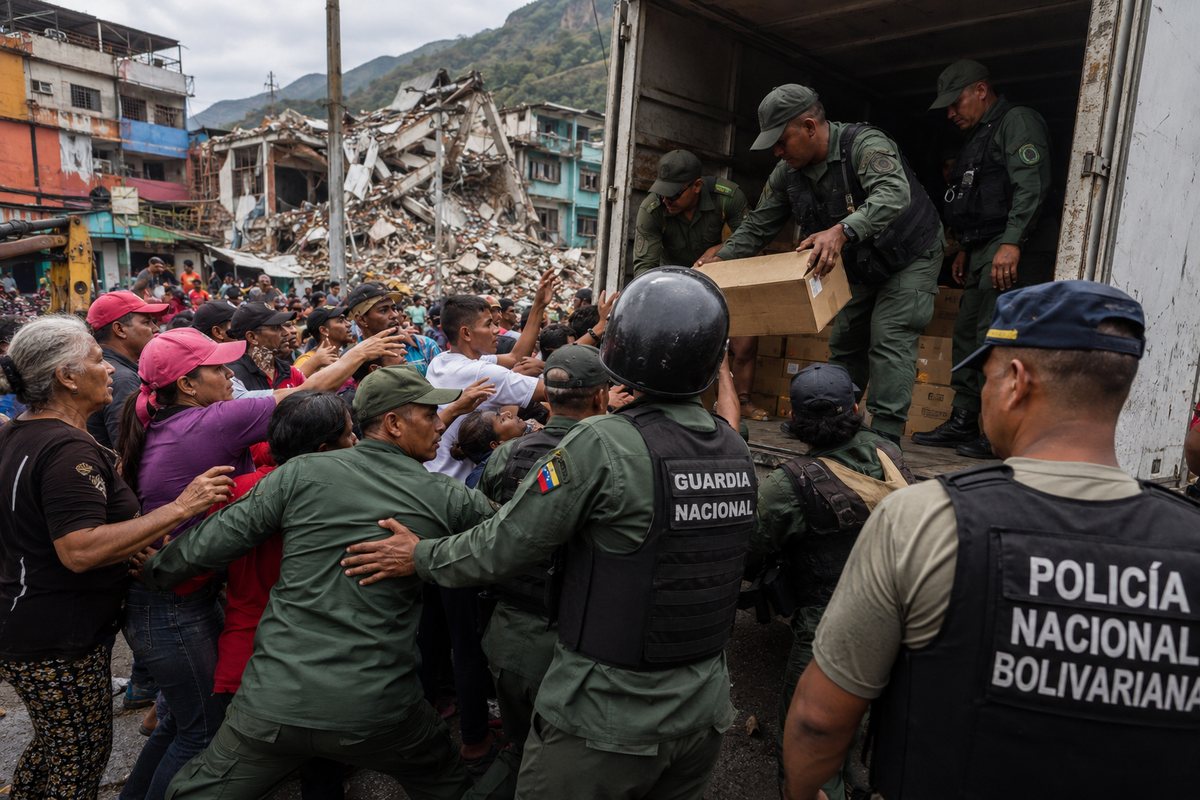
In the testimonies gathered over recent hours, particularly delicate allegations recur: officials and security forces accused of retaining or diverting supplies; military personnel said to have prevented volunteers and relatives from entering critical areas; local authorities denounced for restricting independent collection centres; survivors claiming to have been subjected to filters, credentials or political cards in order to receive assistance; and rescue workers who allegedly encountered discretionary obstacles when attempting to enter sectors where people were still being searched for beneath the rubble.
The first duty of the State in a catastrophe is to save lives. The second, inseparable from the first, is not to appropriate the emergency. Humanitarian aid does not belong to the government, nor to the party, nor to a regional authority, nor to an armed body. It belongs to the victims. Any attempt to administer it as spoils, propaganda, reward or mechanism of obedience turns relief itself into an extension of the harm.
One of the most sensitive concerns is the control of access to devastated areas. Every rescue operation requires order, security and technical coordination. No one can deny that, after an earthquake, certain areas must be protected because of structural risk, aftershocks or the need to keep routes clear for emergency vehicles. But that legitimate authority becomes abuse when exercised without clear criteria, when it prevents relatives from searching for their own, when it detains trained volunteers without sufficient explanation, or when it turns security into a political frontier.
The official response has sought to project control of the situation through announcements of deployment, the reception of international co-operation and calls for calm. Yet the reality described by numerous citizen voices reveals a country in which many communities have had to act before the institutions: neighbours removing rubble with improvised tools, families sleeping in open spaces, doctors asking for basic supplies, patients without adequate care, and areas where the presence of the State appears more effective at controlling than at assisting.
Particular concern has been raised by allegations involving collection centres organised by civic networks and independent organisations. In an emergency of this nature, civil society is not an administrative adversary, nor a threat to the monopoly of power; it is an indispensable reserve of assistance. Water, food, clothing, medicines, torches, batteries, blankets and hygiene items cannot be trapped in disputes over control. When a collection centre is harassed or dismantled without transparency, aid is not being ordered: the social capacity to respond where the State fails to arrive is being weakened.
Allegations of charges, demands for political identification or conditions imposed before receiving assistance must also be investigated with the utmost rigour. In an emergency, the only admissible credential is need. Priority is not determined by affiliation, loyalty, registration in an official system or proximity to a structure of power. It is determined by vulnerability: children, the wounded, older adults, people with disabilities, pregnant women, chronically ill patients, displaced families and households unable to return to compromised buildings.
The disaster has also exposed the precariousness of public infrastructure deteriorated over many years. The earthquakes did not invent the fragility of the health system, the shortage of ambulances, the lack of specialised equipment, the politicisation of security bodies or the absence of reliable mechanisms of accountability. The tragedy made visible, in a matter of seconds, what opacity had been accumulating for years: a State with too much capacity to watch and too little capacity to protect.
International assistance may alleviate part of the damage, but by itself it does not guarantee that aid will reach affected families properly. In a country whose institutions are subject to political control, every donation requires traceability. It is not enough to announce aircraft, cargo shipments or tonnes of supplies. It must be known who receives them, who classifies them, who distributes them, according to what criteria, to which communities, under whose supervision and through what public record. Transparency is not a courtesy in times of disaster; it is a condition of survival.
Allegations of looting, diversion or retention of aid cannot be reduced to scattered comments or passing outrage. Each case must be documented. Each obstruction of rescue workers must be explained. Each collection centre that has been intervened must be identified. Each official accused of conditioning assistance must answer before an independent investigation. In a catastrophe, arbitrariness is not a bureaucratic defect: it may decide who receives water, who reaches a hospital, who is rescued in time and who is left behind.
The indignation of Venezuelans expresses something deeper than immediate grief. It is the reaction of a society which, confronted with material ruin, also recognises institutional ruin. The protest is not only against the slowness of a response; it is against the suspicion that even relief may be subordinated to the logic of control that has marked Venezuelan public life for years.
Venezuela needs rescue, shelter, medicines, water, equipment and technical assistance. But it also needs elementary guarantees: verifiable humanitarian corridors, protection for volunteers, access for civil society organisations, non-discriminatory distribution, public records of supplies and safe mechanisms for reporting abuse. Without those guarantees, aid risks becoming yet another contested territory, precisely when it should be the one morally untouchable space.
The victims of the earthquakes cannot be trapped between the force of nature and the arbitrariness of power. The catastrophe has already produced enough abandonment. If aid is diverted, conditioned or administered as an instrument of control, the disaster ceases to be merely natural and acquires a human responsibility that no government can conceal behind communiqués, uniforms or photographs of distribution.